B2B Software Procurement Shifting to AI Agents
Vendors must now optimize websites for AI agents, not just human buyers.
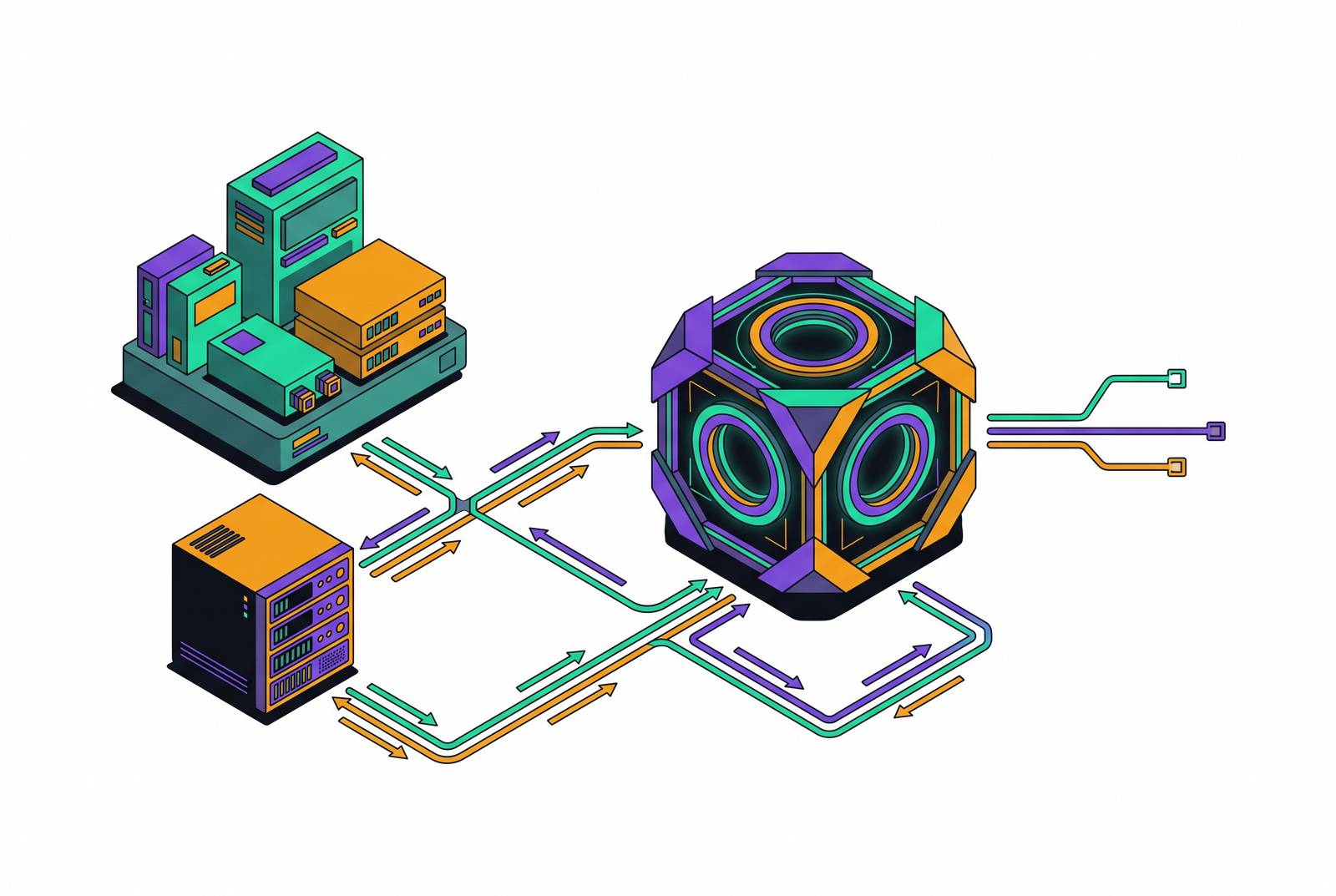
Eight in ten B2B technology buyers now use AI agents somewhere in their purchasing process https://www.marketscale.com/industries/software-and-technology/80-of-b2b-tech-buyers-now-use-ai-agents-forcing-procurement-and-sales-teams-to-rebuild-how-enterprise-deals-get-done. That figure describes the present. Just over half of B2B buyers, 51%, start their vendor research inside an AI tool rather than a search engine, and 87% say AI chatbots have already changed how they research software https://sell.g2.com/2026-buyer-behavior-report. Gartner's projection, drawn from a survey of 646 B2B buyers and 509 supply chain leaders worldwide, puts a number on where this is headed: 90% of B2B purchases intermediated by AI agents within three years, moving more than $15 trillion in annual spend, about half of US GDP, through automated exchanges https://www.digitalcommerce360.com/2025/11/28/gartner-ai-agents-15-trillion-in-b2b-purchases-by-2028/.
That number isn't decoration for a keynote slide. It describes a structural rearrangement of who reads a vendor's website first. When a buyer delegates research to an agent, the agent becomes the first reader of a spec sheet, the first evaluator of a pricing page, and the party deciding which companies make the shortlist. Everything downstream, the demo call, the procurement committee, the signature, depends on that first read going well. A homepage used to persuade a person. Now it has to clear a machine's parsing logic before a person ever lays eyes on it, and most vendors have not rebuilt their sites with that fact in mind.
An AI procurement agent's software evaluation process
A chatbot answers a question and forgets it. A procurement agent works nothing like that. It holds a persistent state across the length of a sourcing project, sometimes weeks long, and it remembers the budget ceiling, the stakeholders, the evaluation criteria, and the surrounding context even after a pause. If a sourcing event stalls two weeks waiting on legal, the agent doesn't restart from zero when it resumes https://www.supplychainbrain.com/blogs/1-think-tank/post/43687-why-2026-is-the-year-of-ai-agents-for-autonomous-procurement. It picks the thread back up where it left off, which is a different kind of memory than anything a marketing team has had to design around before.
The evaluation sequence runs in a fairly fixed order. The agent discovers vendors through machine-readable channels, matches product specs against the buyer's stated requirements, pulls pricing in real time through an API rather than a quote-request form, scores each candidate on landed cost and compliance, submits a structured RFQ, and returns a ranked recommendation for a human to sign off on. Multiple specialized agents often split that work. A sourcing agent hands its findings to a risk agent, and once a risk threshold gets crossed, that escalates to a compliance agent, each one passing context forward instead of starting its own research over.
None of this replaces the human decision-maker, not yet. Comparing total cost of ownership (51%), building vendor shortlists (51%), and researching solutions generally (49%) are the most common agent use cases https://sell.g2.com/2026-buyer-behavior-report. Human approval still governs the high-value calls. But by the time a person sees the recommendation, the shortlist has already been drawn, and the vendors left off it were usually excluded automatically, with no one ever reviewing that exclusion.
Thin, unstructured, or login-walled product information and its silent removal of vendors from shortlists
An agent can only rank what it can actually read. That sounds obvious, but it's the exact mechanism doing most of the damage right now, and there's no rejection notice attached to it. The vendor simply doesn't appear.
Structured data has moved from nice-to-have to gatekeeping requirement. Its absence disqualifies a vendor by default because the agent had nothing to parse. Quoting has shifted the same direction: agents submit RFQs through APIs and expect a structured quote back within seconds, evaluated automatically against landed cost, delivery timelines, and compliance flags. A vendor whose only quoting mechanism is a contact form and a two-day turnaround has already lost the round before a sales rep even opens the inbox https://www.supplychainbrain.com/blogs/1-think-tank/post/43687-why-2026-is-the-year-of-ai-agents-for-autonomous-procurement.
Inconsistent language on a site does real damage here, more than most marketing teams assume. Calling a feature "workflow automation" on one page and "orchestration engine" on another can lead an agent to read those as two separate capabilities rather than one https://www.supplychainbrain.com/blogs/1-think-tank/post/43687-why-2026-is-the-year-of-ai-agents-for-autonomous-procurement. A human visitor would gloss over that kind of inconsistency without a second thought. An agent builds a fragmented picture of the product from it instead, and incomplete product attributes, PDF-only spec sheets, and login-walled pricing pages exclude a vendor before any human ever sees the shortlist.
Traditional social proof (logos, testimonials, PDF case studies) and its failure of the agent's verification test
The tools that made social proof work on a human buyer don't translate. The visual cues that build instant credibility with a person carry no signal at all to a system reading raw text and structured fields, and vendors relying on those cues are optimizing for an audience that no longer does the first pass.
The trust architecture between two agents doesn't resemble a human relationship in any way https://www.supplychainbrain.com/blogs/1-think-tank/post/43687-why-2026-is-the-year-of-ai-agents-for-autonomous-procurement. When an agent representing one company's procurement system reaches out to a vendor's systems, the exchange opens with a cryptographic handshake and a permission check. There's no equivalent of a buyer recalling that a competitor's rep gave a good demo last year. The interaction starts cold, and it starts on protocol.
Static claims fail for a related but distinct reason: nothing about them can be checked. A PDF testimonial, a logo on a homepage, a headline claiming "used by 500 companies," all share the same defect. An agent has no way to confirm any of it reflects real, current usage, because none of it links to an independent verification endpoint it can query. The claim sits there, unconfirmable, and an agent built to score on evidence has no reason to weight it.
Buyer trust data backs up how far the bar has moved, and the direction is not close. Buyers, and the agents acting on their behalf, have gotten more skeptical of unverified claims at exactly the moment vendors are making more of them. The mechanisms that made social proof work for human buyers, logo walls, star ratings viewed in a browser, polished PDF case studies, are largely invisible or uninterpretable to an agent scanning for machine-parseable evidence. Salesforce found measurable outcomes (32%) and transparency about what the AI does (23%) are now the dominant buyer criteria, while buyer trust in vendor AI ethics fell from 58% to 42% between 2023 and 2025 https://elogic.co/blog/ai-agents-b2b-buying/.
Machine-verifiable proof and its effect on the competitive calculus
The requirement is proof an agent can fetch, check, and cite without taking the vendor's own marketing department at its word. Easy to state, harder to build. It means claims tied to a specific customer, a specific feature, and live usage data, reachable through a structured endpoint rather than frozen text on a landing page.
Standards infrastructure for this is arriving faster than most vendors have noticed. Cryptographic Provenance Attestation, or CPA, is a signed statement bundling a cryptographic hash of a piece of content with metadata about where it came from, letting any downstream system check both that the content hasn't been altered and that it actually originated where it claims to. That is not a concept invented for vendor marketing, and it did not appear because AEO needed it. It exists because agent-to-agent commerce needed a way to verify provenance at scale.
Agent identity infrastructure is showing up alongside it. The Agent Name Service, an IETF Internet-Draft that has not yet reached proposed-standard status, maps an agent's identity to its verified capabilities, its cryptographic keys, and its endpoints, functioning as a kind of PKI-backed directory so agents can find each other securely. NIST launched an AI Agent Standards Initiative in February 2026, aimed squarely at this problem. None of it is finished infrastructure. The W3C Verifiable Credentials Data Model v2.0 was published May 15, 2025, and VCDM v2.1 sits as a Working Draft as of April 9, 2026. But the standards layer for machine-verifiable claims now exists at the recommendation level, the same tier of maturity as the web standards already running browsers and payment systems, and verification is becoming a protocol layer rather than a marketing decision.
Agent Experience Optimization as the discipline that ties discovery, readability, and proof together
Citation authority is not link authority, and vendors still budgeting as if it were are misreading the entire shift. An agent doesn't cite a page because other pages link to it. It cites a source because that source carries clear data presence, well-defined entity prominence, and content built around verifiable statistics rather than persuasive prose. That's a real change in where a B2B brand needs to put its visibility budget, and most budgets have not caught up to it yet.
The timing lines up with a broader contraction elsewhere. Gartner projected traditional search volume would drop 25% in 2026 as agents take over more of the product research that used to run through a search box https://elogic.co/blog/ai-agents-b2b-buying/. Citations in Google AI Overviews from pages ranking in the top 10 fell from 76% to 38%, and the click-through rate for the top organic ranking has dropped 64% https://elogic.co/blog/ai-agents-b2b-buying/. AEO is growing precisely because the channel it targets is expanding while the legacy channel it's replacing shrinks underneath it.
A tooling market has already formed around the discipline, and the money moving into it says something about how seriously the space is being taken. Scrunch built what it calls an Agent Experience Platform, or AXP, serving AI-optimized content to agents directly at the CDN layer without changing what a human visitor sees on the same page. Its core tier prices at $250 a month, its agency core tier at $500 a month, with enterprise pricing handled case by case https://elogic.co/blog/ai-agents-b2b-buying/. Conductor sits further up the market, an enterprise platform typically running $10,000 or more a year on custom contracts. Profound closed a $96M Series C at a $1B valuation in February 2026, pushing its total raised past $155M in 18 months, the largest funding signal yet in the AEO tooling category https://elogic.co/blog/ai-agents-b2b-buying/.
Consolidation is occurring even as new entrants continue to enter the market. Semrush, a name most marketers still associate with keyword research and legacy SEO, was acquired by Adobe for roughly $1.9 billion in a deal that closed in April 2026 https://elogic.co/blog/ai-agents-b2b-buying/. That reads less like Adobe buying a search tool and more like a signal that SEO tooling is folding into broader marketing platforms precisely because AEO has emerged as a distinct need those platforms don't yet cover on their own. Adobe's own data backs the urgency: AI-referred traffic converts roughly 42% better than traffic from traditional search https://elogic.co/blog/ai-agents-b2b-buying/. On the agency side, Minuttia built what it calls a Trust Alignment Network, pairing agent analytics that track how AI systems discover and cite content with digital PR work aimed at building third-party consensus around a brand for AI citation purposes, having moved to an AEO-native methodology across 2024 and 2025.
Discovery, readability, and proof used to be three separate marketing problems, handled by three different teams with three different budgets. An agent doing procurement research does not separate them. It reads a vendor's structured data, checks whatever proof it can verify, and builds a shortlist in one pass. AEO (Agent Experience Optimization) has emerged as a distinct professional discipline with its own vendor and agency ecosystem in 2026, distinct from SEO. Supply chain management software with agentic AI capabilities will grow from under $2 billion in 2025 https://elogic.co/blog/ai-agents-b2b-buying/. Supply chain management software with agentic AI capabilities will grow to $53 billion in annual spend by 2030 https://elogic.co/blog/ai-agents-b2b-buying/. 60% of enterprises will adopt agentic features in supply chain management software by 2030 https://elogic.co/blog/ai-agents-b2b-buying/. 45% of B2B suppliers say they use AI in sales functions https://elogic.co/blog/ai-agents-b2b-buying/. Of the 45% of B2B suppliers who use AI in sales, only 24% have implemented agentic AI https://elogic.co/blog/ai-agents-b2b-buying/. 87% of sales orgs use AI in some form https://elogic.co/blog/ai-agents-b2b-buying/. 82% of links cited by AI systems come from earned media https://elogic.co/blog/ai-agents-b2b-buying/. More than 95% of AI citations come from non-paid coverage https://elogic.co/blog/ai-agents-b2b-buying/. Buyer trust in vendor AI ethics was 58% in 2023 https://elogic.co/blog/ai-agents-b2b-buying/. 71% of buyers want a human to validate AI outputs https://elogic.co/blog/ai-agents-b2b-buying/. 69% of buyers chose a different vendor than they originally planned based on AI guidance https://elogic.co/blog/ai-agents-b2b-buying/. 63% of buyers used AI during their purchase journey according to TrustRadius' B2B Buying Disconnect Report https://elogic.co/blog/ai-agents-b2b-buying/. 94% of buyers fact-check AI recommendations https://elogic.co/blog/ai-agents-b2b-buying/. Generative AI adoption in procurement increased from 50% to 94% between 2023 and 2024 https://www.supplychainbrain.com/blogs/1-think-tank/post/43687-why-2026-is-the-year-of-ai-agents-for-autonomous-procurement.
Sources
- AI Agents Are Learning to Buy. Is Your B2B Stack Ready to Sell to Them?
- Gartner: AI agents will command $15 trillion in B2B purchases by 2028
- 80% of B2B tech buyers now use AI agents, forcing procurement and sales teams to rebuild how enterprise deals get done
- Why 2026 Is the Year of AI Agents for Autonomous Procurement
- sell.g2.com
- sell.g2.com